MILITARY F196 Cavity Transmitter Tuner Radio Vhf Filter 184-205MHZ
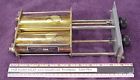
( Brand: Military ), ( Part Type: Transmitter Tuner Radio Filter ), ( Country/region Of Manufacture: United States )
Review MILITARY 184-205mhz Cavity Plated Transmitter Tuner Radio Vhf Filter Gold
The 184-205 MHz Cavity Military Transmitter Tuner F196 Radio VHF Filter is an essential component for any military or professional radio communication system. This high-quality filter is designed to operate within the VHF (Very High Frequency) band, specifically between 184 and 205 MHz.
The filter is constructed using cavity technology, which provides excellent attenuation, selectivity, and phase stability. This technology ensures that the filter can effectively block unwanted signals and frequencies, while allowing the desired signal to pass through unattenuated. The result is a cleaner, clearer radio communication signal with reduced noise and interference.
The F196 filter is made of high-quality materials and is designed to withstand harsh military environments. It is built to be robust and reliable, with a rugged construction that can withstand extreme temperatures, humidity, and vibrations. The filter is also resistant to dust and other particulate matter, ensuring that it continues to function effectively even in the most challenging conditions.
The F196 filter is easy to install and use. It is designed to fit directly into radio communication systems, with simple connections that require no special tools or expertise to install. The filter is also compact and lightweight, making it easy to transport and use in the field.
In summary, the 184-205 MHz Cavity Military Transmitter Tuner F196 Radio VHF Filter is a high-performance, reliable, and robust filter that is essential for any military or professional radio communication system. Its cavity technology provides excellent attenuation, selectivity, and phase stability, while its rugged construction ensures that it can withstand harsh military environments. The filter is easy to install and use, and is compact and lightweight, making it an ideal choice for use in the field.
Pros of buying an 184-205 MHz cavity military transmitter tuner F196 radio VHF filter:1. High quality: This filter is designed for military applications, which means it is built to last and provides high-quality signal transmission.
2. Frequency range: The filter covers a wide frequency range, making it suitable for various VHF communications.
3. Reliability: Military-grade equipment is known for its reliability, reducing the risk of signal interruptions or losses.
4. Customizable: The F196 filter can be customized to meet specific requirements, providing a more tailored solution.
Cons of buying an 184-205 MHz cavity military transmitter tuner F196 radio VHF filter:1. Cost: Military-grade equipment is often more expensive compared to commercial alternatives.
2. Complexity: The filter may require specialized knowledge and expertise to install and maintain, which could add to the overall cost and complexity.
3. Availability: Due to its military application, the filter might be less readily available in the commercial market, making it harder to find and purchase.
Conclusion:If you require a high-quality, reliable VHF filter for military or security applications, an 184-205 MHz cavity military transmitter tuner F196 radio VHF filter could be an excellent investment. However, consider the cost and potential need for specialized knowledge and expertise before making a purchase. If you need a more cost-effective solution, there might be commercial alternatives with similar functionality that can meet your requirements.
Details:
Useful for many tuning filter interference or antenna applications in your ham shack each section is tenable, but they are coupled together in series.
Loop coupling between cavities.
The usual high quality Military construction with the elements of gold plated brass. Parts breakdown picture shows the internal construction of a similar cavity filter easily disassembled with screwdriver and wrenches.
Fair radio sales. Type n connectors on back of cavity assembly.
F 196 dual gold plated cavity tuner mhz from the Military TRX 24 radio relay communications system.
The internal components can be modified to cover other frequencies and it should not be a problem to move it to a different frequency. The internal parts pictured are of a higher frequency cavity, but you can see how they are built.
part #: f196 prices
- $89.95-$195.00
specifications speakepar:
- brand: Military
- part type: Transmitter Tuner Radio Filter
- country/region of manufacture: United States
Seller speakepar:
- zipcode: 45804
- city: Lima, Ohio
Offer speakepar:
- # Sold: 0
- # bids: 0
- best offer: false
- Started: November 23, 2015, 4:12 pm
- quantity: 3
Payments speakepar:
- PayPal
- VisaMC
- Discover
General speakepar:
- in stock: Yes
- Consumer Electronics > Radio Communication > Parts & Accessories > Tuners
- condition: New other see details
Returns speakepar:
- policy: no returns
Shipping speakepar:
- type: Calculated
- handling: 10 days
Ratings:
- Good bargains, great packing, fast shipping. Thank you! AAA+++ 11-16-15
- Great assortment of tools - Fast shipper +++ 11-13-15
- Perfect 11-16-15
- Tnx, Just what I needed. AAAA++++ 11-14-15
- Great to deal with - speedy shipping - thanks! 11-19-15
Military F196 Is Similar To:
- 1025 Mfd 1 16 Plate Spacing Unbranded-generic Military Single Section Variable (36.1% similar) I am always happy to answer any questions. Rugged build, smooth rotating rotor shaft. One 1 variable capacitor out of Military transmitter. 73 de Tim AE7TH. This cap weighs five 5 pounds. Cap could be used in RF or antenna tuner project. Large dielectric connector bar on each side of cap. 1/1 6 air ...(March 14th, 2017)
- Military Rng Cay-47515 4 Gp-7 Parts Rf Antenna Tuner Xmtr Nice (19.4% similar) WWII early 1940'S Westinghouse electric manufacturing company type Can range b plug in tuning unit for GP 7 aircraft radio equipment. This is a best effort and I cannot guarantee that it is completely correct so bid accordingly. Item is appears to be complete and in good to very good overall ...(May 25th, 2015)
- Ls0019 Speaker 5 8 Replacement Radio Cone Ohm Treated Surplus 3 Military (39.5% similar) Looks like the cone has some sort of treatment applied to it, maybe water sealer. Buyer to pay economy shipping always happy to combine multiple items for shipping. 8 ohms impedance. Is 8 ohms making this approx...(May 12th, 2015)
- 30mhz 229-20201s Watt Antenna Transmitter Coil Military Origin Roller Tuning Tuner Or Plate 200 Rf 3 (45.7% similar) With auto stopping kit and drive pulley. 5 long x 3 sq. Was motor driven in mil. Roller tuning coil for antenna tuner or transmitter plate coil 200 watt RF mhz with 27 turns on ceramic core from Miltonic's model 229 2020 1S. Automatic antenna tuner set...(October 1st, 2016)
- Rt1539 Military Truck Humvee Rt524 Radio Antenna Matchbox Hva-9 (21.2% similar) RT524 radio antenna matchbox hvac FSCM67032 antenna marcher or couplet. Misbehaves. It is painted ARC green. It may be a duplexes or a dip lexer. J1 j2 are n connectors, j3 is a four pole male connector, MIT binding posts, and rec. It has the following nomenclature fs cm FCC 550 230NN3 FSCM53779 ...(July 14th, 2016)
- Choke Military Grade Tf1rx04 Filter (27.2% similar) Physically, it's in very good condition see photos. Electrically, when tested using a wavelike inductance meter LRC55 the choke's two indicators were measured at 7. To any location in the lower 48 states. By the part number it appears to be a dual filter choke built to meet mil 27 specifications for...(May 25th, 2015)
- Tuner Military Radio Turns Vintage Inductor Ham Counter Dial Roller (23.2% similar) This dial measures 4 inches square and it has a nice large crank spinner tuning knob and lock. It takes 20 turns of the crank tuning knob to cover the calibrated range and the 1/4 inch rear output shaft turns 1 to 1 with the crank knob. Since this is a used, vintage item it is being offered as found...(June 6th, 2015)
- 184-205mhz F-196 Various F196 Vhf Cavity Filter Radio Tuner Transmitter Military Gold Plated (88.9% similar) The internal parts pictured are of a higher frequency cavity, but you can see how they are built. Loop coupling between cavities. Useful for many tuning filter interference or antenna applications in your ham shack each section is tenable, but they are coupled together in series. Type n connectors ...(July 8th, 2016)
- 374-404 F-204 Various Uhf Mhz Cavity Filter Radio Tuner Transmitter Military Gold (71% similar) Useful for many tuning filter interference or antenna applications in your ham shack each section is tenable, but they are coupled together in series. The usual high quality Military construction with the elements of gold plated brass. Fair radio sales. F 204 uhf mhz cavity filter radio tuner ...(December 29th, 2015)
- Rf-3054 Harris Loadspeaker Radio Speaker Wire Military (42.3% similar) We attempt to verify operation when possible but given the complexity of some equipment, may not be able test each and every knob function. Assume if it is not listed probably included. 319 Harris loudspeaker RF-3054, n, 8 ohms, radio extension speaker, Military has threaded post with a bracket and ...(July 11th, 2021)
- Reproducer Guided Radio Corp L-144 Vintage Speaker Military Ham Working (35% similar) Vintage guided radio corp reproducer speaker L-144 Military ham working, estate find, USA navy radio reproducer speaker, found this in a box with new old stock parts working condition assuming it was never used see pictures for all details fast free shipping speaker...(January 30th, 2024)