CUSTOM Bessel Pole Filter 9.5
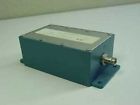
( Brand: Custom ), ( Part Type: Pole Filter )
Review CUSTOM Bessel 9.5 Mhz Pole Filter
The Bessel 9.5 pole filter is a sophisticated digital signal processing component, renowned for its exceptional performance in reducing noise and distortion in electronic systems. This filter, specifically a 9.5 pole Bessel filter, is an advanced variation of the standard Bessel filter. The "pole" in this context refers to the number of zeros that the filter's transfer function has in the left half of the s-plane.
The 9.5 pole designation indicates a high order filter, which provides a sharp roll-off in the frequency response. This results in excellent attenuation of high-frequency noise and interference, making it ideal for applications where precise filtering is required. The Bessel 9.5 pole filter is particularly notable for its linear phase response, which ensures that time-domain signals pass through the filter without distortion or delay.
The Bessel 9.5 pole filter is designed to have a flat passband and a gradual roll-off in the stopband. This allows it to efficiently eliminate unwanted frequencies while preserving the desired signal components. The filter's design also ensures minimal group delay, which is crucial for maintaining the phase relationship between different frequency components in the input signal.
The Bessel 9.5 pole filter is typically implemented in digital form, using algorithms like the bilinear transform or the impulse invariance method. It can be easily integrated into digital signal processing systems using software development platforms or specialized hardware.
In summary, the Bessel 9.5 pole filter is a powerful digital signal processing tool, offering high-order filtering with minimal distortion and delay. Its linear phase response, flat passband, and gradual roll-off make it an excellent choice for applications demanding precise and reliable noise reduction.
Pros of buying a Bessel 9.5 pole filter:1. High-quality filtering: Bessel filters are known for their high-quality filtering capabilities, providing a smooth transition between pass and stop bands.
2. Minimal phase shift: Bessel filters have a minimal phase shift, which means that the signal is delayed by a small amount when it passes through the filter, resulting in less distortion.
3. Linear phase response: Bessel filters have a linear phase response, which means that the delay is constant across the frequency range. This results in a more natural sounding filter.
4. Reduced ringing: Bessel filters have reduced ringing, which means that there is less oscillation of the signal when it passes through the filter, resulting in a cleaner sound.
Cons of buying a Bessel 9.5 pole filter:1. Complex design: Bessel filters have a more complex design than other types of filters, which can make them more expensive to manufacture and more difficult to implement in a digital signal processing system.
2. Limited bandwidth: Bessel filters have a limited bandwidth, which means that they may not be suitable for applications that require wideband filtering.
3. Increased computation time: Due to their complex design, Bessel filters can require more computation time to implement, which can impact the performance of real-time systems.
Conclusion:Bessel 9.5 pole filters offer high-quality filtering with minimal phase shift, linear phase response, and reduced ringing. However, they have a complex design, limited bandwidth, and increased computation time. If you require high-quality filtering with minimal distortion and a natural sound, then a Bessel 9.5 pole filter may be a good choice for you. However, if you require wideband filtering or need to optimize computation time, then you may want to consider other types of filters.
Recommendation:I recommend considering your specific application requirements before deciding on whether to purchase a Bessel 9.5 pole filter. If you require high-quality filtering with minimal distortion and a natural sound, then a Bessel 9.5 pole filter may be a good choice for you. However, if you require wideband filtering or need to optimize computation time, then you may want to consider other types of filters such as Butterworth, Chebyshev, or Elliptic filters. It's also worth considering the price and availability of the filter, as well as the compatibility with your existing equipment and software.
Details:
5 mhz 50 ohms in out low pass on jun at PDT. Custom bessel filter 5 pole 9.
specifications speakepar:
- brand: Custom
- part type: Pole Filter
Shipping:
- type: Calculated
- handling: 1 days
Returns:
- paid by: Buyer
- type: Money Back
- policy: returns accepted
- time: 30 Days
- details: 30-DAY SATISFACTION GUARANTEECall us at 805 648-3300 with any questions or concerns we will make it right. Our Customers are our highest priority. If you are not completely satisfied with your purchase, please within 30 days of your purchase and we will refund 100% of your purchase price. All returns must include all original undamaged items, in resalable condition with all original packaging including manuals, and accessories. Media, Books, and Software are non-refundable. Shipping and Handling fees are non-refundable and the buyer is responsible for return item shipping costs.
Seller:
- zipcode: 93001
- city: Ventura, California
Payments:
- PayPal
Offer:
- best offer: true
- quantity: 1
- # bids: 0
- Started: June 11, 2015, 8:54 am
- # Sold: 0
Ratings:
- Great buying experience! 06-10-15
- good transaction 06-10-15
- Fast delivery 06-11-15
- Thanks would use again! 06-11-15
- Great products, just as advertised. Very pleased. A+++ 06-11-15
General:
- Consumer Electronics > Radio Communication > Parts & Accessories > Tuners
- in stock: Yes
- condition: Used
Custom Is Similar To:
- 20 Mhz Bessel 20mhz Custom 50 Ohms (52.2% similar) Bessel 20MHZ Custom filter 5 pole housing 50 ohms in-out in out technical condition used. This item has been inspected and it is in good condition. 10 x 8/6 inches questions. Approximate shipping weight DIMS3 lbs. If in doubt please by messaging or calling prior to buying. On mar at 12:47:14 PDT...(March 13th, 2017)
- Bessel Filter 20 Mhz Pole 5 Custom (46.4% similar) Custom bessel filter 5 pole 20 mhz 50 ohms in out 33023...(May 11th, 2015)
- Mhz Bessel Custom 6.0 5 Pole Filter (57.1% similar) Mhz mhz 50 ohms in out low pass on jun at PDT. Custom bessel filter 5 pole...(June 11th, 2015)